
Stephen Douglas
Girdling Roots: The Long-Term Damage Hidden Beneath Improper Planting
The tree looked fine when it was planted. It leafed out that first spring. It survived the first summer. For a while, no one had reason to question it. Then something changed.
The canopy thinned. Growth slowed. Leaves came in smaller sizes. One side seemed weaker than the other. Irrigation was checked. Fertilizer was applied. Blame shifted to weather, soil, or disease.
But in many cases, the real problem started years earlier — on the day the tree went into the ground.
As a professional arborist working in the Pacific Northwest, I see this pattern repeatedly in developments less than fifteen years old. Trees planted too deep, trees planted too high, improper staking, volcano mulching stacked like a chimney. But the most consistent and most damaging issue I encounter is this: trees planted with the burlap and bindings still wrapped around the root ball and even the trunk.
It may seem minor during installation, but it can set a tree up for decades of struggle, and often an early death. From the outside, the tree may still look acceptable. But underground, the damage has already been done.
A tree rarely fails the year it’s planted. In fact, most planting mistakes don’t reveal themselves for five, seven, or even ten years.
But in many cases, the real problem started years earlier — on the day the tree went into the ground.
As a professional arborist working in the Pacific Northwest, I see this pattern repeatedly in developments less than fifteen years old. Trees planted too deep, trees planted too high, improper staking, volcano mulching stacked like a chimney. But the most consistent and most damaging issue I encounter is this: trees planted with the burlap and bindings still wrapped around the root ball and even the trunk.
It may seem minor during installation, but it can set a tree up for decades of struggle, and often an early death. From the outside, the tree may still look acceptable. But underground, the damage has already been done.
A tree rarely fails the year it’s planted. In fact, most planting mistakes don’t reveal themselves for five, seven, or even ten years.
Why Burlap and Bindings Become a Problem
Homeowners, landscapers, and even some tree workers often assume burlap is harmless because it’s “biodegradable.” The reality is that it doesn’t break down nearly fast enough to allow proper root expansion. In many cases, treated burlap or synthetic twine can remain intact for years, long after the tree should have expanded beyond its original root ball. Instead, it confines the roots. Those roots begin circling, and over time, they tighten around the trunk.
This is where girdling roots form, roots that compress the cambium layer, the tissue responsible for transporting water and nutrients. When that system is restricted, the tree can’t grow properly, can’t defend itself, and eventually begins to decline.
Above ground, it looks fine. Below ground, it’s slowly being strangled.
A Field Example: A Tree That Never Had a Chance
Field Case Study — Chanticleer Pear (Pyrus calleryana)
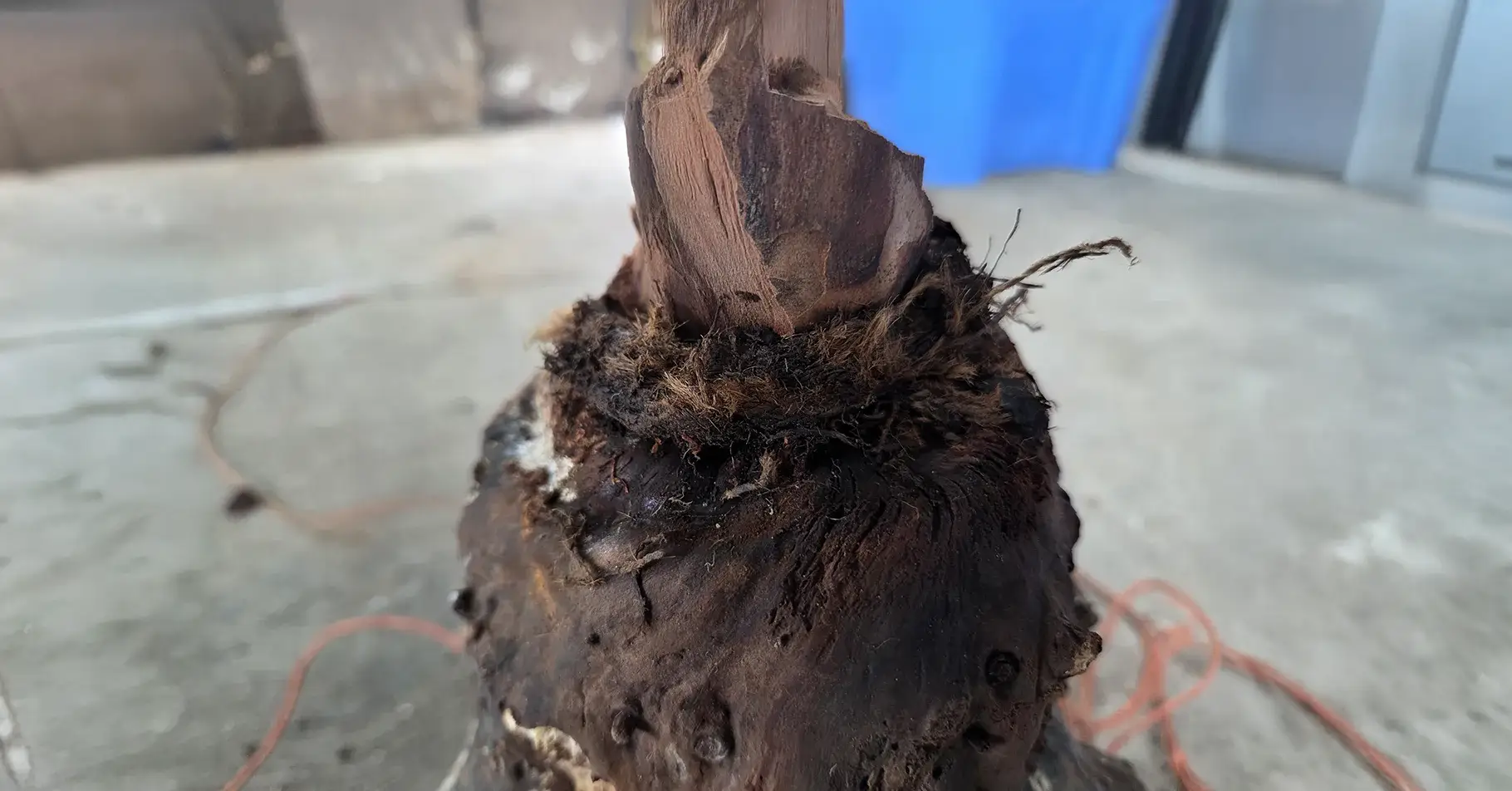
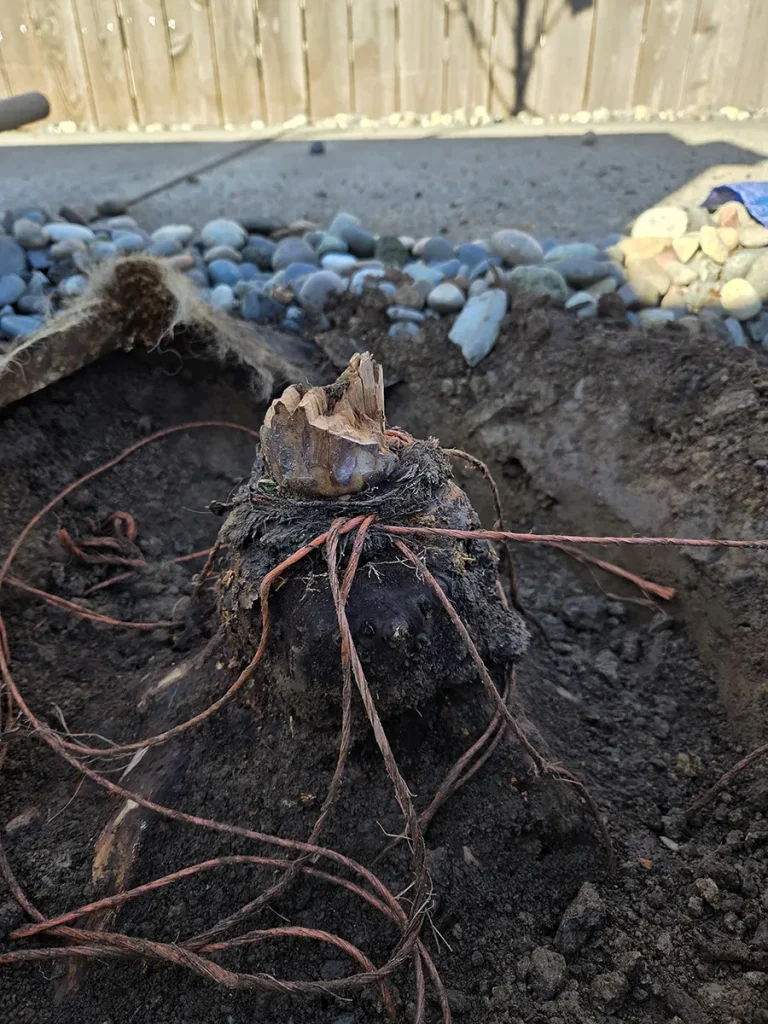
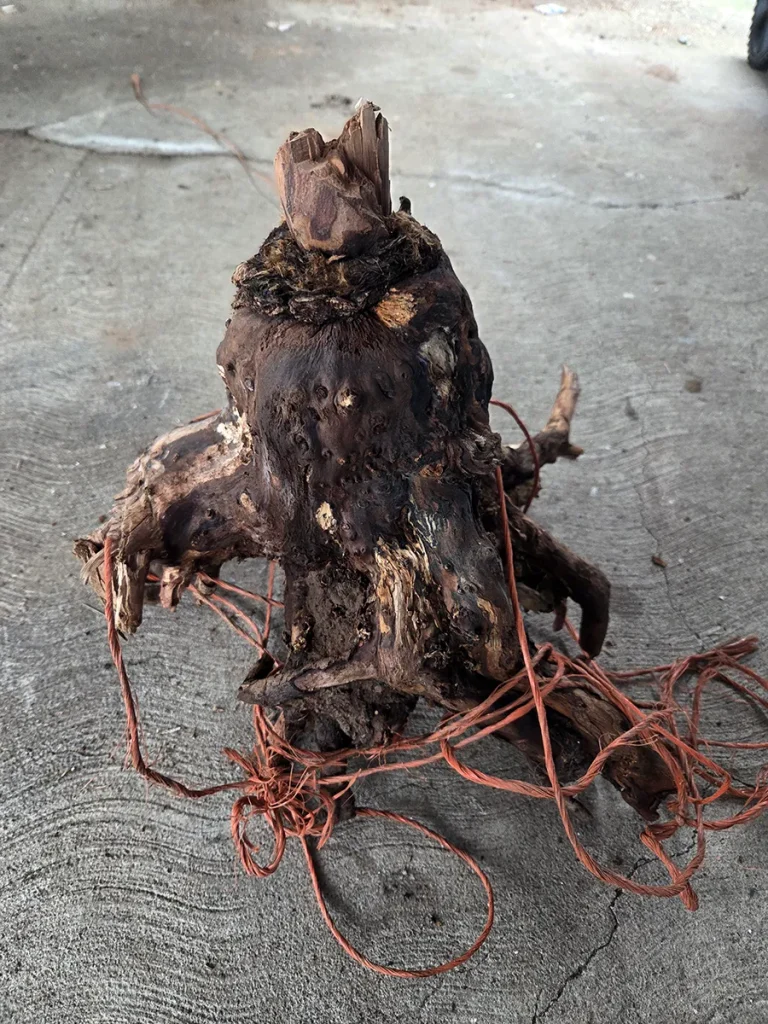
One recent job illustrates this perfectly. The tree was a Chanticleer Pear, a common ornamental species in many Pacific Northwest subdivisions. Chanticleer Pears are typically grafted right at or above the root flare. This one had a 1.5-inch caliper when it was planted; at the time of removal, it was only a 2-inch caliper. It was installed with the burlap intact and the binding still cinched tightly around the trunk just below the graft union.
+0.5″
Girdled tree caliper growth
over 7 years
+1.5–2.5″
Neighboring trees caliper growth
same period, same variety
Seven years later, the tree had gained only half an inch in caliper. Then it died. The surrounding trees of the same variety, without the girdling, had grown approximately 1.5-2.5 inches in caliper over the same period.
When I exposed the base, the cause was obvious: a severely girdled root flare. The tree had been fighting a losing battle since the day it was planted. After recommending removal and replacement, we dug the stump out by hand. Below the girdled flare, the trunk had attempted to expand to nearly 6 inches, but the binding had prevented any meaningful growth above ground.
This wasn’t a disease issue. It wasn’t drought stress. It wasn’t soil conditions. It was simply improper planting.
The Commercial Impact
What makes this issue especially costly is that it rarely affects just one tree. On commercial properties, installation practices are typically consistent across an entire project. If burlap and bindings were left intact on one tree, there’s a strong chance they were left on dozens.
The problem compounds quietly. For the first few years, everything appears acceptable. Then decline begins — uneven growth along rows, isolated dieback, trees that never quite “catch up” to their neighbors. By the time symptoms are obvious, warranty periods have expired, and replacement costs fall squarely on ownership.
What appears to be scattered underperformance is often a systemic installation error. And when that error repeats across a site, it becomes a long-term capital expense — not just a horticultural issue.
The Auxin-Cytokinin Pathway: Why Girdling Roots Disrupt Tree Growth
Trees rely on a hormonal communication system between the canopy and the root system. Two of the most important hormones involved are auxins and cytokinins.
Auxin is produced in the shoot tips and moves downward. It regulates apical dominance and signals the roots to grow.
Cytokinins are produced in the roots and move upward. They promote cell division and stimulate shoot and bud growth.
Together, they form a feedback loop: the canopy regulates root growth, and the roots regulate canopy development. For the tree to function normally, these hormones must move freely through the vascular system.
When girdling roots compress the cambium, that transport pathway is restricted. The hormonal signals can’t move between the roots and shoots, and the tree loses its ability to grow, adapt, and defend itself. Over time, this breakdown in communication contributes to decline and eventual failure. It’s similar to pinching a major artery in the human body. The structure remains intact, but communication and nourishment are compromised. The structure of the body is still there. From a distance, everything appears intact. But circulation is compromised. Nutrients don’t move efficiently. Stress responses weaken.
In trees, this disruption doesn’t cause immediate collapse. Instead, it leads to chronic underperformance. Growth slows. Defense mechanisms weaken. The tree becomes less resilient to heat, drought, pests, and soil stress. Over time, that reduced resilience adds up.
This is why girdling roots are so deceptive. The damage is physiological long before it is visible.
In the case of the Chanticleer Pear, the binding below the graft didn’t just choke the trunk; it cut off this hormonal communication entirely.
Application: What to Look For and What to Do
The early signs of girdling roots are often visible long before a tree begins to decline. Start at the base of the trunk. A healthy tree should show a clear root flare. If the trunk enters the soil like a telephone pole, straight and narrow, with no visible flare, it’s a strong indication the tree was planted too deeply or that excess soil and mulch have buried the flare. Slow caliper growth, thin or uneven canopy development, and early fall color are also common indicators that the vascular system is being restricted below ground. On commercial properties, you may also notice inconsistent growth patterns along rows of the same species. When one tree lags significantly behind its neighbors, installation depth should be investigated before assuming irrigation or fertility issues.
If a tree looks suspicious, gently expose the top inch or two of soil around the trunk by hand. Even minimal excavation often uncovers circling roots or, in many cases, the original burlap and twine still wrapped tightly around the base. Once exposed, minor girdling roots on young trees can be corrected with careful pruning; older trees require more caution. When the trunk has been constricted for years, the damage is usually permanent, and removal typically is not far down the line.
Preventing these issues is far easier than correcting them. Proper planting begins with locating the root flare before the tree is set in the ground, removing the burlap, twine, and wire, correcting any circling roots, and setting the tree at the correct depth.
One of the most overlooked details is that the true root flare is often buried inside the nursery container or root ball. Soil and substrate can accumulate several inches above the actual flare before the tree even arrives on site. If crews plant at the visible soil line without correcting that depth, the tree may already be set too deep before it enters the ground.
Finding and exposing the true flare takes a few extra minutes. Removing burlap, cutting twine, and correcting circling roots take a few more steps. In the rush of installation schedules, those minutes are often sacrificed.
Yet those small steps determine whether a tree thrives for 30 or 40 years, or struggles from year one. It’s a stark contrast: minutes during installation versus decades of performance.
Mulch should be applied minimally and kept away from the trunk so the flare remains visible. These steps take minutes during installation but can add decades to a tree’s lifespan and determine whether it will thrive for decades or struggle from the moment it’s planted.
Conclusion
Girdling roots are among the most common and preventable causes of tree failure in new developments. When trees are planted improperly, they struggle from day one. They never establish themselves correctly. They never reach their potential. And many die long before their time.
As arborists, landscapers, and homeowners, we all share responsibility for getting planting right. A few extra minutes during installation can mean decades of healthy growth rather than years of decline.
For homeowners, proper planting protects more than the tree itself. Mature, healthy trees provide shade, improve curb appeal, reduce energy costs, and contribute directly to property value. When a tree declines prematurely, that long-term benefit disappears before it ever fully materializes.
For commercial property managers, the stakes are even more practical. Trees are part of capital planning. They shape the tenant experience, parking-lot comfort, and overall site aesthetics. When installation errors shorten a tree’s lifespan, replacement cycles accelerate. Budgets tighten. Landscapes fail to mature as designed.
A tree that survives only ten years instead of thirty is not just a horticultural loss, it’s a financial one.
And in nearly every case of girdling roots, the cause traces back to the same moment: the day it was planted.
For further reading: ANSI A300 Part 6 (Planting), ANSI A300 Part 8 (Root Management), and research on auxin-cytokinin signaling in Arboriculture & Urban Forestry.
