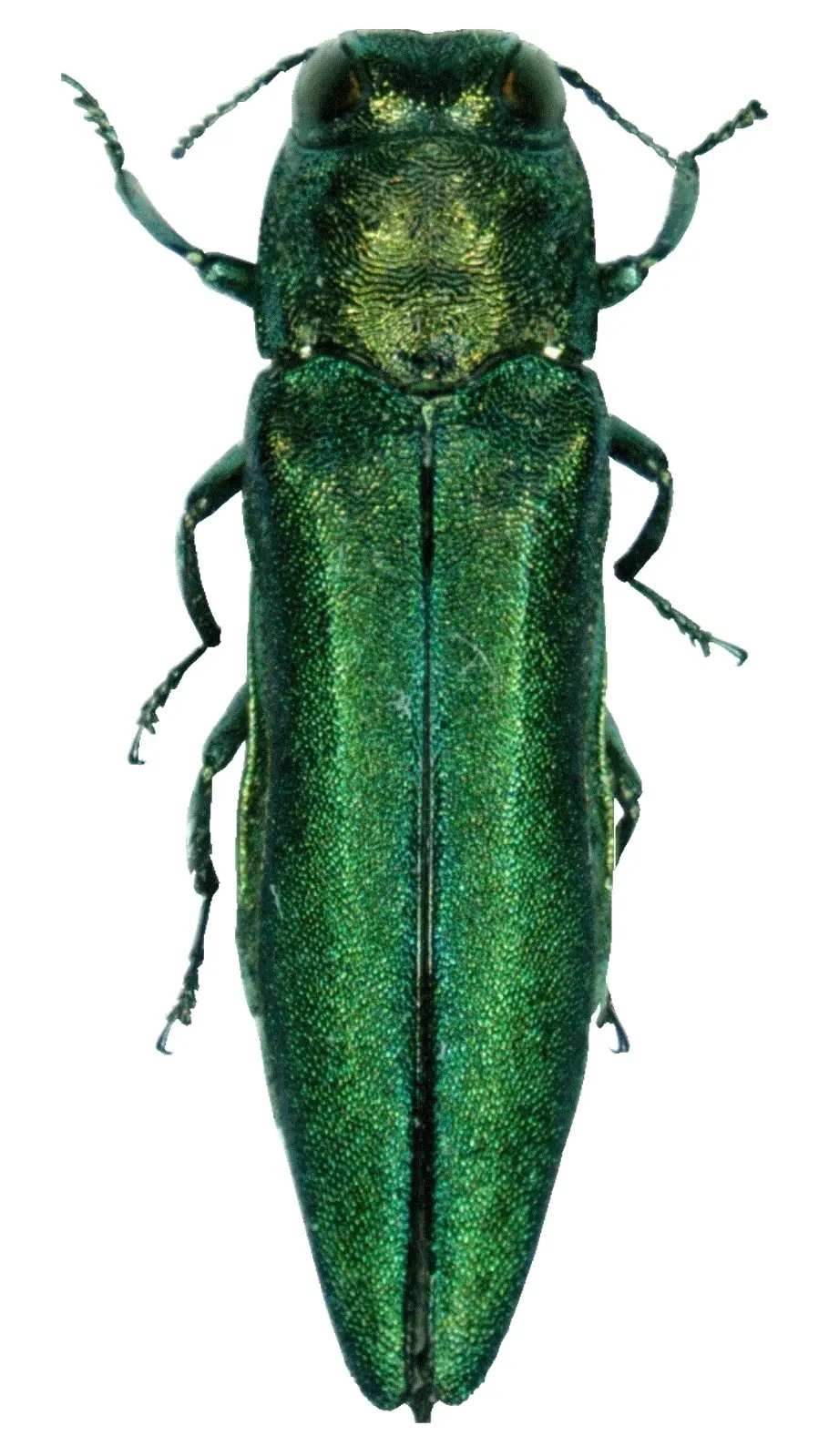
In July we published a guide to the emerald ash borer that opened by saying the beetle had not been confirmed anywhere in Washington, but that it was close and our turn felt like a matter of time. That sentence is now out of date. On August 19, 2026, the USDA confirmed that a beetle collected in Vancouver was an emerald ash borer, the first confirmed detection in Washington state.
It arrived here first. Not Seattle, not Spokane. Clark County.
What was found, and what was not
The distinction in that last bullet matters, because it is the question every ash owner in the county is going to ask first: is it in my neighborhood?
Nobody can tell you that yet, and anyone who does is guessing. What has been confirmed is a single adult beetle, found on a windshield, identified by federal entomologists. State and city officials have not announced a located infestation, a mapped perimeter, or a specific area. If you have heard a particular neighborhood named, in Hazel Dell or anywhere else, that is not something the agencies have published.
Here is why the detection is still serious. An adult emerald ash borer does not fly far under its own power, on the order of half a mile a year. A beetle on a windshield in Vancouver means either it hitched a ride on a vehicle, which is exactly how this insect crosses states, or there is a population somewhere nearby that has been quietly building. Neither is good news, and the second is the more likely of the two. By the time this beetle turns up in a place, it has usually been established there for several years already. That is the pattern everywhere it has gone.
Sven Spichiger, pest program manager at WSDA, put the arrival plainly: "We anticipated it would only be a matter of time before emerald ash borer arrived in our state." Commissioner of Public Lands Dave Upthegrove said much the same: "This is deeply unfortunate, but we knew the emerald ash borer would arrive here and we've been preparing for it."
Worth noticing: this was found by two people who saw a strange bug, thought it was worth keeping, and reported it. Spichiger's other comment was that "alert, observant members of the public help us detect new, invasive pests." That is not a courtesy line. It is the actual detection system.
What changes for Clark County tree owners
Three things changed on August 19.
The treatment threshold is now met. Our earlier guide cited WSU's guidance to begin considering preventive treatment once the beetle is confirmed within roughly 30 miles. Confirmed in Vancouver puts every part of Clark County inside that radius, from Ridgefield to Washougal. If you have been treating this as a someday decision, it is now a this-year decision.
There is a clock, and it is not long. A Washington DNR analysis found that without active management, a municipality should expect to lose 90 to 100 percent of its ash tree inventory within 10 to 12 years of an initial infestation. Nationally the beetle has killed more than 100 million ash trees since it turned up in Michigan in 2002.
Eradication is not on the table. Oregon's Department of Forestry states it directly: EAB cannot be eradicated, and once it arrives in an area it does not go away. Everything from here is management. What is actually available is limiting firewood movement, treating individual trees worth protecting, and replacing the ones that are not.
The firewood quarantine that took effect August 18 is the piece that applies to everyone regardless of whether they own an ash. Untreated firewood is the vehicle this insect uses to travel hundreds of miles at a stretch. Buy it where you burn it.
Do you actually have an ash tree?
Most people are not sure, which is reasonable, because ash is not the tree anyone around here brags about. But Oregon ash is native, it is the only ash native to the Pacific Northwest, and it is scattered all over this county in the wet ground it likes: creek bottoms, floodplains, ditch lines, and the low corner of a yard that stays soggy until April.
That description covers a lot of Hazel Dell, Salmon Creek, Felida, Orchards, and the Burnt Bridge Creek corridor, not because a beetle has been reported there but because that is where the ash trees are. If your property has a damp low spot with a big deciduous tree in it, that tree deserves five minutes of your attention this month.
The City of Vancouver's identification shorthand is a good one: opposite buds, diamond-shaped ridged bark, five to nine leaflets on each leaf stalk, and paddle-shaped seeds. Opposite branching is the fastest check, since very few trees here grow their twigs in matched pairs directly across from each other. Two or three of those traits together and you have an ash. Our earlier post covers identifying an ash tree and reading the damage signs in more detail, including the D-shaped exit holes and the S-shaped galleries under the bark.
Treat or replace: the thresholds that actually decide it
This is where people want a rule, and there is a usable one. Oregon's Department of Forestry publishes the clearest treatment guidance in the region, and these are its thresholds.
- Treat before infestation, not after. Treatment can still work in the early stages, but only if the tree has not lost more than 30 percent of its canopy. Past that, it stops being reliable.
- Healthy and large trees are the candidates. ODF points to healthy ash of six inches diameter and up as the best prospects, because they have the highest survival odds and provide benefits a newly planted tree cannot replace for decades.
- It is permanent. Given current technology, a treated ash has to be treated for the rest of its life, because the beetle stays in the landscape indefinitely. This is a subscription, not a cure.
- The method matters enormously. Systemic trunk injection of emamectin benzoate is the most effective option, applied every two to three years, best in spring after leaves emerge, and only while the tree is in leaf. Cover sprays are among the least effective, because they do not reach the larvae under the bark.
- It requires a license. Emamectin benzoate and most other effective EAB treatments may only be administered by a licensed pesticide applicator.
ODF also notes that treatment is the less expensive path in the near term, and estimates a tree can be treated for roughly 20 years before the accumulated cost matches removing and replacing a healthy tree. That is a genuinely useful frame for deciding: if this tree matters to you for the next two decades, treatment pencils out. If it does not, it does not.
Where we fit in: an ISA Certified Arborist on our team can walk your property, tell you which trees are ash, and assess whether a given tree is a real treatment candidate against those thresholds. We handle the treatment side as well. We diagnose the tree, write the prescription, and manage the emerald ash borer treatment from there, with the application itself performed by a licensed pesticide applicator.
If you want that assessment in writing for an HOA, an insurer, or your own records, we can put it in an arborist report. And if the answer turns out to be removal and replanting, that is our work too. Either way it starts the same way, with someone looking at the tree, so reach out for an evaluation and we will come read it for you.
For what it is worth, the City of Vancouver is making the same call on public trees: injecting mature ash in good condition on a routine cycle, removing the smaller ones under about ten inches and the declining ones, and replanting with species the beetle does not attack.
Why a dead ash is a different job than a dead fir
Ash wood goes brittle unusually fast once the tree dies. Limbs that looked sound snap without much warning, and the structure degrades faster than most homeowners expect from watching other dead trees. That has two consequences.
The first is safety around the tree, for anyone walking under it and for anyone working in it. The second is that a dead ash gets progressively harder to remove. A tree that a climber could work this fall may not be climbable next year, at which point the job needs a crane instead. Waiting does not make this easier or cheaper, and the direction of travel is only one way. If you have an ash that is already declining, deal with it while the wood is still sound. Our guide to deciding when a tree has to come down covers the general version of that judgment.
Also worth keeping in view: this lands on top of four consecutive drought years that already have trees across the county running on reserves. Stress stacks. The same dynamic is killing Douglas firs here right now, and an ash that is drought-stressed is an ash with less capacity to resist anything else.
Four things not to do
- Do not move firewood. The quarantine took effect August 18 and it exists for exactly this reason. Buy firewood where you burn it.
- Do not panic-remove a healthy ash. A sound mature ash with a full canopy is a treatment candidate, not a write-off. Removing it now forfeits an option you still have.
- Do not diagnose from one photo. Several harmless native insects get mistaken for this beetle every year. Report it and let the entomologists call it.
- Do not plant a new ash. Vancouver stopped planting them in 2022. Whatever the replacement tree is, make it something else.
If you think you have found one
Report suspected sightings through the Washington Invasive Species Council or the WA Invasives app. Inside city limits you can also reach Vancouver Urban Forestry at 360-487-8325 or urbanforestry@cityofvancouver.us. If you can, do what the people who found this one did: photograph it, and keep the specimen.
One practical reminder that catches people out: a confirmed pest does not suspend the local tree rules. Removals inside Vancouver still require a permit, and the rest of the county has its own requirements depending on jurisdiction. Our post on tree removal permits in Clark County covers who you answer to.
Where this leaves an ash owner this month
- Work out whether you have an ash at all, using opposite branching and compound leaves as the quick screen.
- If you do, get its condition assessed now, while a healthy tree still has every option open to it.
- Decide deliberately whether it is a tree you would commit to treating for the long haul or one you would rather replace on your own schedule.
- Stop moving firewood, and tell the neighbor with the trailer full of rounds.
- Report anything that looks like the beetle rather than assuming somebody else already did.
The beetle arriving was not a surprise to anyone who watches this, and it does not mean every ash in Clark County is lost. It means the decisions that were theoretical in July are real in August. Priority Tree Service covers all of Clark County, and if you want an ISA Certified Arborist to tell you honestly which of your trees are ash and what shape they are in, that is a straightforward visit.
Sources reviewed August 25, 2026: WSDA news release on the first Washington detection, Washington Invasive Species Council, emerald ash borer, City of Vancouver Urban Forestry, emerald ash borer, Oregon Department of Forestry, EAB insecticide treatments, The Columbian, and OPB.