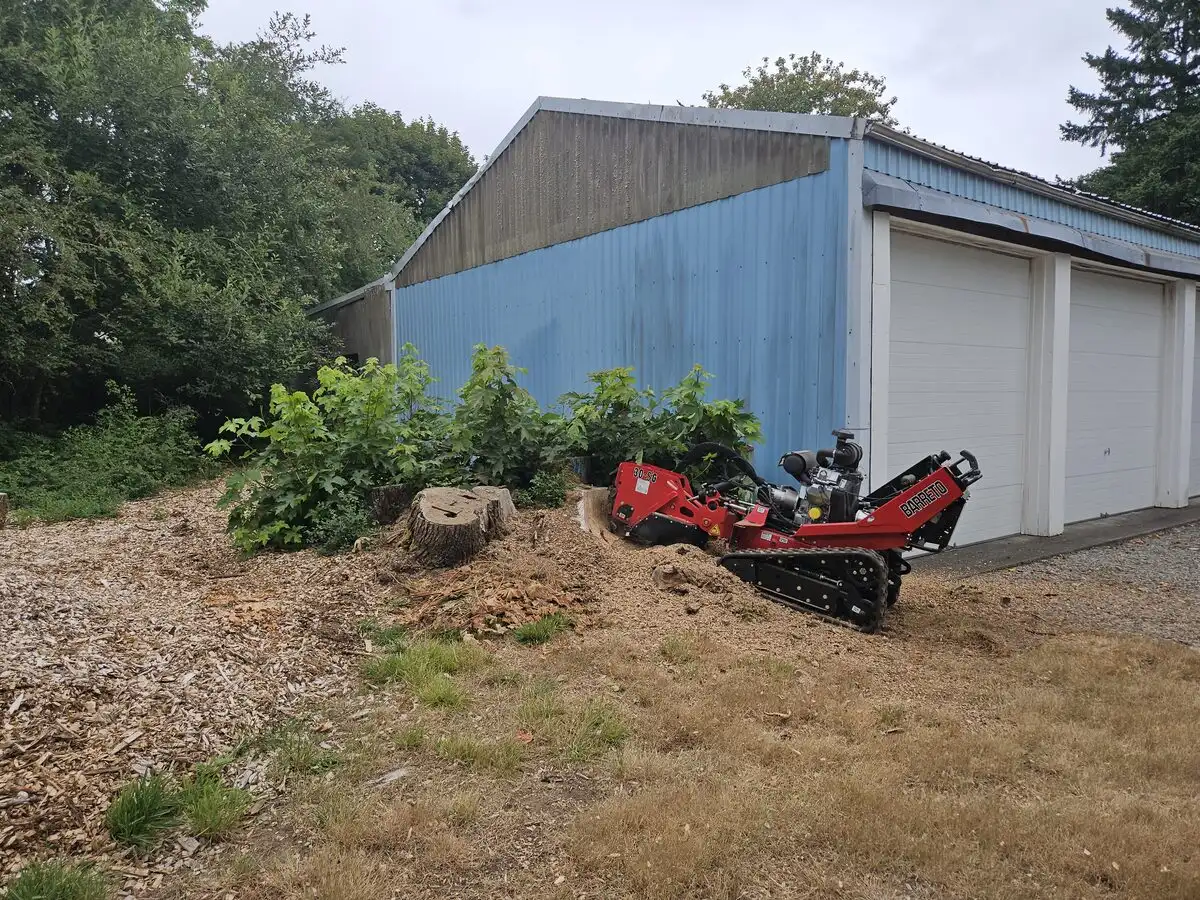
The grinder gets loaded up, the truck pulls out, and you are standing in the yard looking at a low mound of pale wood chips where a stump used to be. The stump is gone, which is what you asked for. Now what?
This is the part of the job nobody explains, and getting it wrong is why some people end up with a permanent sunken dead spot in an otherwise fine lawn. Here is what is actually under that mound and what to do with it.
What is still in the ground
Stump grinding removes the stump and the root flare down to a set depth. It does not remove the root system. The lateral roots are still out there, running under the lawn, and they will spend the next several years quietly decaying. For almost every purpose that is completely fine.
You should also expect the ground opening to be wider than the stump was. A grinder has to take out the flare, and on a big tree that flare spreads well past the trunk, so the disturbed area often comes out noticeably larger than the stump you were looking at. What fills it is a mix of wood chips, sawdust, root fragments, and soil.
That mix is the thing to deal with. Everything else takes care of itself.
The grindings are not topsoil
The temptation is obvious: rake the pile flat, throw grass seed on it, done by lunch. It does not work, and the reason is worth understanding.
Fresh wood chips have a very high carbon-to-nitrogen ratio. As soil organisms break them down, they pull available nitrogen out of the soil to do it, which is exactly the nitrogen new grass needs to establish. Iowa State Extension's guidance on this is direct: the grindings "should be removed as thoroughly as possible before planting grass." Chip-heavy soil also dries out fast, which works against seed germination and root development at the same time.
Two good things to do with the grindings instead:
- Use them as mulch on beds and around other trees. Spread two to four inches deep and keep it a few inches back from any trunk. This is genuinely useful material in the right place, and it holds soil moisture, which matters more than usual after four dry years.
- Have them hauled off. Say so when you book the work. Whether the chips stay or go is a normal thing to specify up front and an annoying thing to sort out afterward.
Turning the spot back into lawn
If you want grass there, the sequence is straightforward and mostly about patience.
- Dig the grindings out of the top several inches, as thoroughly as you have the energy for. Wheelbarrow them off to a bed.
- Backfill with quality topsoil to replace the volume the grinding removed.
- Mound it slightly above the surrounding grade. This looks wrong on day one and correct three months later. The fill will settle, and the remaining roots decaying underneath will keep settling it for a while.
- Water it and let it sink, then top it up again. Expect to add soil at least twice. Core aeration in the area helps if the ground got compacted by the machine.
- Seed or sod only once the site is level, debris free, and settled. Around here the reliable seeding window is early fall, when the rain does the watering for you. Sod can go down through the growing season and covers faster.
Rushing straight to step five is the single most common reason a ground stump turns into a bare patch that never fills in.
Planting a new tree in the same spot
This one comes up constantly, and the answer is usually no.
The old hole is a bad home for a new tree. It is full of decaying wood that will keep tying up nitrogen, it is going to settle unevenly for years, drainage in it is unpredictable, and the wood-decay fungi that were working on the old root system are still there. A young tree dropped into that starts its life at a disadvantage it does not need.
Better options, in order of how much work they take:
- Move over. Plant six to eight feet away from the old stump and the problem disappears entirely.
- Wait. Give the site a year or two for the coarse roots to break down, keeping it topped up as it settles.
- Excavate. If the new tree genuinely has to go in that exact position, the root plate gets dug out and the hole backfilled with imported soil. That is a different job from grinding, involving different equipment, so mention it before the grinding is scheduled rather than after.
Sprouts coming up after the stump is gone
You ground the stump and now there are shoots pushing up through the lawn in a ring around where it was. The tree is not coming back. Those are root suckers, running on energy the root system stored before the tree came down.
Some species do this far more than others. Cottonwood, poplar, aspen, black locust, cherry, tree of heaven, and some maples are the usual offenders around Clark County. Grinding deeper takes out more of the stored reserves and reduces it, but roots spread well beyond any grinder, so it does not always stop it.
The fix is simple and slightly tedious: cut or mow the sprouts every single time they appear. Roots cannot recharge without leaves, so each round of shoots is drawing down a bank account with no deposits going in. Stay consistent through a season or two and they stop. Pulling one sprout and hoping, or letting a corner of the yard go for a month, resets the clock.
Five things to settle before the grinder shows up
Most of the annoyance after stump grinding comes from decisions nobody made beforehand.
- Depth. Lawn, a new planting, a patio, a fence post, and a driveway all need different depths. Say what the spot is going to become.
- Chips. Staying as mulch, moved to a bed, or hauled away.
- Utility locates. Call 811 at least two business days ahead. Grinders reach deeper than people expect and gas, power, and communication lines are all worth knowing about.
- Private lines. 811 does not mark irrigation, low-voltage lighting, invisible pet fence, or septic components. Those are yours to point out, and they are the ones that actually get cut.
- Access. A grinder needs a path to the stump. Gate width, slope, and soft ground all matter, and it is better to know about a 30 inch gate before the truck arrives.
Getting it done
Priority Tree Service handles stump grinding across Clark County, both as the finish on a tree removal and as standalone work on stumps that have been sitting for years. If you want to see how sites look when the work is finished, our recent jobs cover plenty of both. And if the stump is still attached to a tree you are unsure about, start with whether it needs to come down at all.
Sources reviewed August 25, 2026: Iowa State University Extension, planting grass after stump removal, International Society of Arboriculture mulching guidance, and Washington 811 utility locate service.