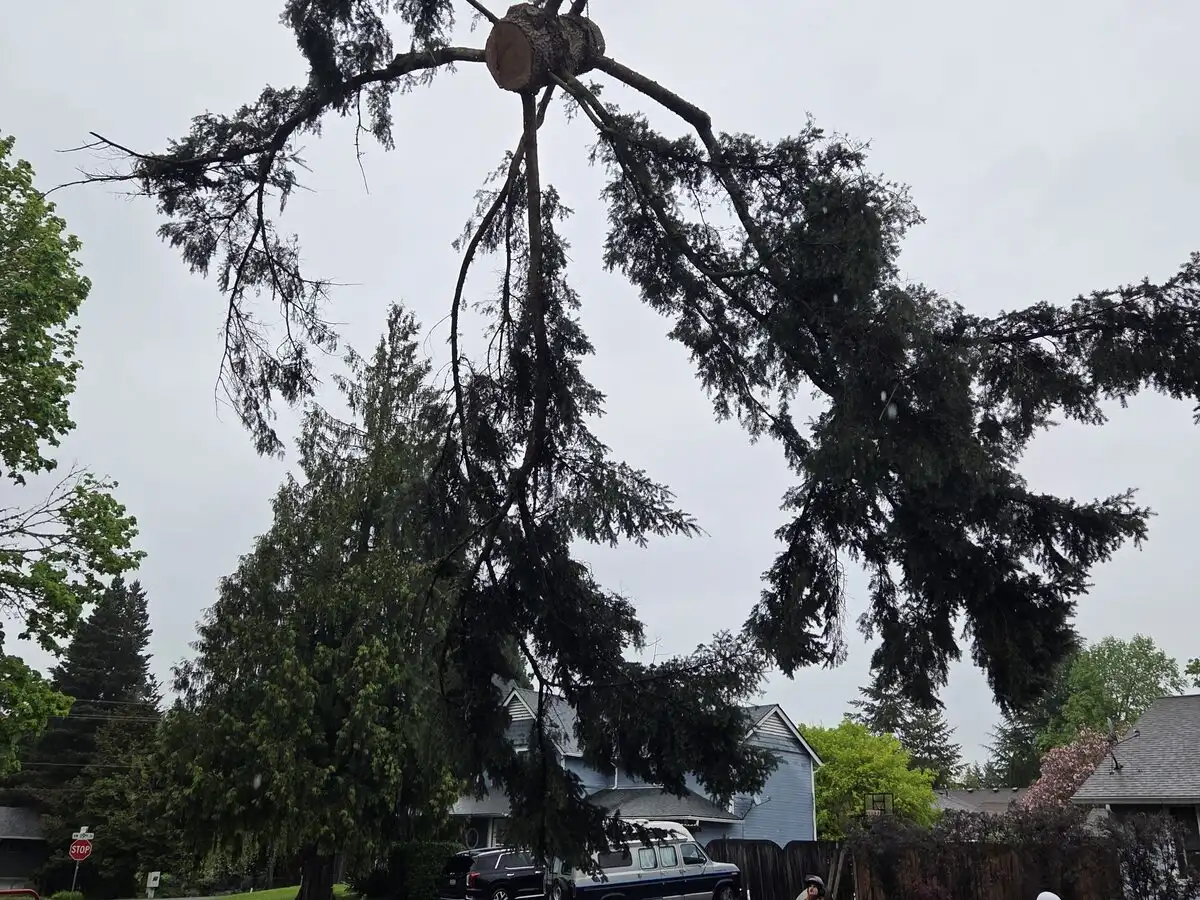
A branch from next door is scraping your roof, dropping debris into your gutters, or taking over the sunny side of your yard. It is tempting to point at the fence, fire up a saw, and solve the problem in an afternoon. That is exactly when a straightforward pruning job can turn into a damaged tree or a neighbor dispute.
There is no responsible one-word answer
Can you trim the branch? An arborist should not answer that question with an automatic yes. Before anyone cuts, there may be several separate questions to sort out: Where is the surveyed property line? Who owns the tree? Would the crew need access from next door? Could the proposed cuts harm the tree? Is a permit or utility clearance involved? And do the neighbors agree about the plan?
The Clark County Law Library lists overhanging or damaging branches among common neighbor concerns. Clark County also publishes a tree-overhang handout, but that document expressly says it is not legal advice and directs people seeking a legal opinion to an attorney. Treat those pages as starting points for your own research, not as permission to cut.
What to do before you schedule pruning
1. Start with a calm conversation
Show your neighbor the branch and explain the practical concern. A photo can help when the issue is difficult to see from their side. Ask whether they already have a tree-care plan and whether they are open to an arborist looking at the whole tree. A shared plan is much better for the tree than two separate pruning decisions.
2. Do not ask the tree crew to guess the boundary
A fence, hedge, mowing line, or row of shrubs does not give an arborist enough information to determine a legal property boundary. If the location is uncertain, pause the project and use the appropriate property records or a licensed surveyor. Priority Tree Service can assess a tree, but we cannot establish a property line or decide who owns it.
3. Have the proposed cuts assessed as part of the whole tree
A limb that crosses an invisible line is still attached to a living structure. Its diameter, attachment, weight, position, and share of the live canopy all matter. Removing too much foliage or making a large cut in the wrong place can create decay, weak regrowth, or an unbalanced crown. Root cutting can also affect tree health and stability.
An ISA Certified Arborist can inspect the tree and explain whether selective pruning can create the needed clearance without sacrificing sound tree structure. That is a tree-care opinion, not a legal opinion. For a closer look at proper alternatives to severe cutting, read our guide to why professional arborists do not top trees.
4. Check the rules and utilities that apply to the site
Before work begins, ask the government office responsible for the property whether the particular tree or work requires review. Inside Vancouver, the Urban Forestry tree-permit page is the appropriate place to start. Elsewhere in Clark County, check with the city or county that has jurisdiction. An HOA may also have a separate review process.
If any branch is near a power line, keep people and tools away from it. Clark Public Utilities tells customers to contact the utility about trees around its lines and provides a tree-trimming request. Do not make a power-line tree a do-it-yourself project.
5. Make the agreed scope clear
Before the crew arrives, make sure everyone involved understands which branches are being considered, where access would occur, and what the arborist believes can be removed without unacceptable damage to the tree. Putting the proposed scope in a simple email, along with photographs, can prevent an ordinary pruning discussion from becoming a misunderstanding. It is still not a substitute for legal advice when there is a disagreement.
Situations where we recommend pausing
Do not rush into cutting when:
- The trunk appears to sit on or very close to the boundary.
- The requested work would require access from the neighboring property.
- A large, load-bearing limb makes up a significant part of the crown.
- The tree is leaning, cracked, decayed, declining, or recently storm-damaged.
- Roots are lifting pavement, entering a project area, or being considered for cutting.
- The tree or equipment would be close to overhead utility lines.
- Either property owner disputes the boundary, ownership, access, or proposed work.
These conditions can involve tree risk, legal questions, or both. An arborist report can document the tree's observable condition and the pruning options. Only an attorney can advise you about legal rights, liability, or how a dispute should be handled.
What Priority Tree Service can—and cannot—help with
Our ISA Certified Arborist-led team can:
- Inspect the tree's visible condition and structure.
- Explain how a proposed cut may affect tree health and stability.
- Develop a pruning scope focused on clearance and sound arboricultural practice.
- Provide an estimate or, when appropriate, a written arborist report.
- Perform authorized work safely after access and the work area are clearly established.
We cannot determine a property line, establish tree ownership, interpret the law, settle a neighbor dispute, or tell either homeowner what they are legally entitled or required to do. If those questions are unresolved, the tree work should wait.
A better first call than an emergency call
Most overhanging branches are easier to address while the tree is stable, the weather is calm, and both neighbors have time to talk. If you want to understand the pruning options, Priority Tree Service can evaluate the tree and give you a clear tree-care recommendation. If the question is about ownership, boundaries, permission, or responsibility, take that question to a qualified Washington attorney first.
Sources reviewed August 7, 2026: Clark County Law Library neighbor resources, Clark County tree-overhang handout, City of Vancouver Urban Forestry FAQ, and International Society of Arboriculture pruning guidance.